

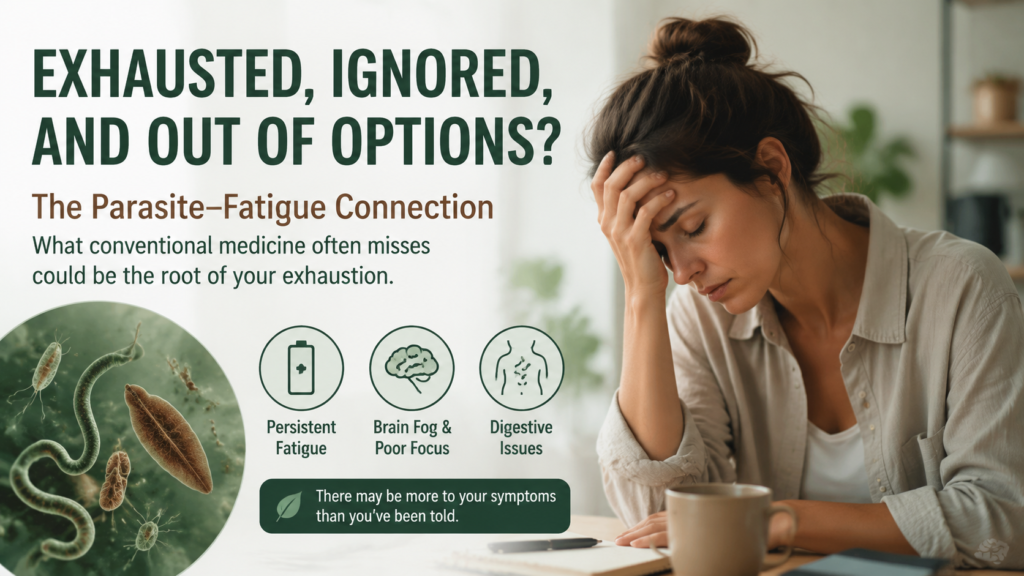
Exhausted, Ignored, and Out of Options: The Parasite-Fatigue Connection

How hidden flukes, roundworms, and tapeworms cause systemic exhaustion, and why normal test results are only half the story.
The Hidden Invaders: Could Parasites Be the Root of Your Chronic Fatigue?
Have you been struggling with exhaustion that simply won’t lift, no matter how much sleep you get? Perhaps you’ve been told you have “chronic fatigue no cure” and have been left to manage the debilitating symptoms on your own. You visit doctor after doctor, only to run into a wall of standard blood panels that come back completely normal. It is incredibly isolating to live with “constant fatigue nothing shows on tests,” wondering if you are imagining your own physical decline.
If you have a collection of “unexplained symptoms doctor dismissed,” you are not crazy, and you are definitely not alone. Often, standard medicine looks for mainstream culprits like thyroid dysfunction, iron deficiencies, or autoimmune conditions. But there is a massive, deeply overlooked root cause that frequently evades standard NHS blood tests: human parasites.
Far from being a problem restricted to tropical travel, parasites are remarkably common in the UK and worldwide. They hijack your nutrients, inflame your gut, release toxic byproducts, and disrupt your nervous system—leading to severe systemic fatigue, brain fog, and chronic illness.
1. The Silent Liver Flukes & Gallbladder Invaders (Trematodes)
Trematodes, commonly known as flukes, are leaf-shaped flatworms. Unlike parasites that stay strictly in your bowel, flukes have a notorious preference for your liver, gallbladder, and bile ducts, causing deep systemic fatigue and metabolic chaos.
- Opisthorchis felineus (Cat Liver Fluke):
- How you catch it: Ingesting raw or undercooked freshwater fish, a common risk for sushi lovers.
- What it does to you: This fluke is a master of systemic disruption. Because it inflames the liver and bile ducts, it triggers a cascade of seemingly unrelated symptoms. You might experience general weakness, dizziness, and excessive sweating. Locally, it causes pain under your right ribs (where your liver sits). Systematically, it can trigger dry skin rashes, eczema, hair loss, food allergies, and painful muscle cramps. One highly classic, overlooked sign is insomnia specifically between 12:00 AM and 2:00 AM—which, in traditional Chinese medicine, is peak “liver time,” when this organ is working hardest to detoxify.
- Clonorchis sinensis (Chinese Liver Fluke):
- How you catch it: Eating raw, undercooked, salted, pickled, or smoked freshwater fish containing the parasite’s larvae.
- What it does to you: Similar to the cat liver fluke, it migrates to the bile ducts of the liver. Over years, a chronic infection can cause severe inflammation, bile duct obstruction, stone formation, and can drastically increase the long-term risk of bile duct cancer (cholangiocarcinoma).
- Fasciola hepatica (Common Liver Fluke / Sheep Liver Fluke):
- How you catch it: Drinking dirty, untreated water or eating raw aquatic plants and vegetables (like wild watercress) that have been watered with contaminated water containing larvae.
- What it does to you: While a chronic infection can sometimes be completely symptomless, it often presents as a persistent, dull stomach ache. Because these flukes live in your bile ducts, they can cause infections of the gallbladder or bile canals, blockages in the pancreas, and, in severe chronic cases, can lead to permanent liver damage like liver cirrhosis (scarring of the liver).
2. The Giant Gut Invaders (Tapeworms / Cestodes)
Tapeworms are segmented flatworms that live in the human intestines. They can grow to shocking lengths—sometimes several meters—quietly stealing your vitamins, minerals, and macronutrients.
- Taenia saginata (Beef Tapeworm):
- How you catch it: Consuming raw or undercooked beef containing tapeworm cysts.
- What it does to you: It is famously sneaky and usually symptomless. When symptoms do appear, they are often subtle—such as a lack of appetite, mild abdominal discomfort, weight loss, or seeing small, moving segments of the worm in your stool.
- Taenia solium (Pork Tapeworm):
- How you catch it: Eating undercooked pork containing larval cysts.
- What it does to you: While it can live quietly in your gut causing mild digestive issues, it poses a much more dangerous threat. If you accidentally ingest the eggs (via poor hygiene or contaminated food), the larvae can hatch, cross your gut wall, and form cysts in your muscles, eyes, or brain—a serious neurological condition known as cysticercosis.
- Echinococcus granulosus (Hydatid Tapeworm / Dog Tapeworm):
- How you catch it: Accidental ingestion of eggs, usually through close contact with infected dogs or eating food/water contaminated with dog faeces.
- What it does to you: Instead of living as a worm in your gut, the larvae migrate to your organs—most commonly your liver and lungs. There, they form slow-growing “hydatid cysts.” These cysts can grow to the size of a tennis ball over several years, putting pressure on your organs, causing chronic pain, cough, or liver dysfunction.
- Diphyllobothrium latum (Broad Fish Tapeworm):
- How you catch it: Eating raw or undercooked freshwater fish.
- What it does to you: This is the largest parasite to infect humans, growing up to 30 feet long. It has a literal “hunger” for vitamin B12, absorbing up to 80% to 100% of your dietary intake. This leads to a severe B12 deficiency and macrocytic anaemia, which is a prime suspect behind that heavy, bone-deep physical and mental exhaustion that feels like “chronic fatigue.”
3. The Crawling Intestinal Intruders (Roundworms / Nematodes)
Roundworms are cylindrical, unsegmented worms. Some are microscopic, while others are highly visible, and they are highly adapted to surviving in the human host for years.
- Ascaris lumbricoides (Giant Roundworm):
- How you catch it: Ingesting microscopic eggs from soil, water, or food contaminated with human waste.
- What it does to you: These worms have a complex lifecycle. Once swallowed, the larvae hatch, burrow through your gut, travel to your lungs (causing a dry cough or wheezing), and are then coughed up and swallowed back down into the gut to grow into adults. A heavy load can cause abdominal pain, nutritional deficiencies, and even physical bowel blockages.
- Enterobius vermicularis (Pinworm / Threadworm):
- How you catch it: Swallowing or inhaling microscopic eggs from contaminated hands, bedding, toys, or clothing.
- What it does to you: This is the most common worm infection in the UK, especially in school-aged children. The adult worms live in the colon, but the females crawl out of the anus at night to lay thousands of eggs around the skin. This causes intense nighttime anal itching, leading to disrupted sleep, irritability, and daytime fatigue.
- Strongyloides stercoralis (Threadworm / Strongyloides):
- How you catch it: Walking barefoot on soil contaminated with larvae, which physically penetrate through your bare skin.
- What it does to you: Strongyloides is unique because it can reproduce inside your body indefinitely (autoinfection). It can cause a localised “creeping” itchy skin rash (larva currens), respiratory symptoms as it passes through the lungs, and chronic digestive issues like watery diarrhoea and stomach cramps. It can persist quietly in your body for decades.
- Trichuris trichiura (Whipworm):
- How you catch it: Ingesting soil-contaminated food or water.
- What it does to you: Shaped like a tiny whip, this worm physically threads its thin end into the lining of your large intestine. Light infections might go unnoticed, but heavy infections cause painful, bloody stools, chronic diarrhoea, anaemia, and intense inflammation.
- Ancylostoma duodenale (Hookworm):
- How you catch it: Walking barefoot on contaminated soil; the microscopic larvae penetrate the skin of your feet.
- What it does to you: Hookworms travel to your small intestine, where they use sharp mouthparts to latch onto your intestinal wall and literally drink your blood. This direct blood loss causes severe iron-deficiency anaemia, leaving you pale, breathless, and utterly exhausted.
4. The Meat & Seafood Hazards (Worms & Protozoa)
- Trichinella spiralis (Pork Worm / Trichina Worm):
- How you catch it: Eating raw or undercooked pork or wild game (like wild boar) containing larval cysts.
- What it does to you: After mating in your intestines, the female releases newborn larvae that travel through your bloodstream and burrow into your skeletal muscle tissue. This triggers “trichinosis,” characterised by intense muscle pain, high fever, swelling around the eyes (periorbital oedema), and profound fatigue as your immune system fights the muscle tissue invasion.
- Sarcocystis (Sarcocystis Species):
- How you catch it: Ingesting undercooked meat containing cysts (which causes a brief, acute stomach bug) or consuming water/food contaminated with animal faeces containing sporocysts (which causes cysts to form in your own muscles).
- What it does to you: Intestinal infections strike quickly—often within hours of eating undercooked beef or pork—bringing on abdominal pain, watery diarrhoea, vomiting, fever, and dizziness. The muscular form is much more chronic, causing persistent muscle aches, weakness, and localised swelling.
- Anisakis (Herring Worm / Cod Worm):
- How you catch it: Consuming raw, undercooked, or inadequately frozen marine fish or squid (such as herring, cod, salmon, or mackerel).
- What it does to you: When you ingest live Anisakis larvae, they attempt to burrow into the wall of your stomach or intestine. Within hours, this triggers sudden, severe abdominal pain, nausea, vomiting, and sometimes a fever. Many people also develop strong allergic reactions, ranging from hives and rashes to life-threatening anaphylaxis.
Why Don’t My Medical Tests Show This?
If you suspect a parasite, why did your doctor’s stool test come back negative?
Traditional stool tests (known as Ova and Parasite, or O&P, tests) are notoriously unreliable for chronic infections. They rely on a technician looking at a single stool sample under a microscope to spot active eggs. However, many parasites lay eggs intermittently, and flukes or tissue-dwelling parasites (like Sarcocystis or Trichinella) do not shed eggs in your stool regularly.
To truly get to the bottom of unexplained fatigue, many functional medicine practitioners recommend:
- Triple-Sample PCR Stool Tests: These look for the actual DNA of parasites, making them vastly more accurate than a visual microscopic scan.
- Blood Panels for Eosinophils and IgE: High levels of eosinophils (a specific type of white blood cell) and elevated IgE antibodies often signal that your immune system is actively fighting off a parasite.
- Comprehensive Detox Support: Supporting your drainage pathways (liver, kidneys, and lymphatic system) is crucial before attempting any herbal anti-parasitic cleanse.
Don’t let your unexplained symptoms be dismissed. If your body is screaming that something is wrong, keep digging, support your gut, and remember that getting healthy again is entirely possible.